Ever!
How do you feel about that statistic?
I personally think it is pretty confronting.
Further to my last Scribbles about global population decline and the Birthgap documentary, I wanted to outline my thoughts on how this might impact the Australian property market.
(if you missed that Scribbles, click here to read it now)
When looking at the Australian birthrate 1.48 (births per women) this puts us way below natural replacement rate and therefore the only way to sustain or grow is to ‘import’ people.
This leads us to immigration.
Immigration is the reason that Australian population is still growing. Not because we are growing ‘naturally’ thought onshore births.
This complicates things dramatically, and here are some reasons why:
1) The dropping natural birth rate necessitates ‘importing’ people if we want to maintain or grow the population
2) The immigrants may have a different demographic makeup compared to current residents. Eg, number of Adults vs children vs babies. This is not inherently a bad thing but does complicate already operating businesses and property that service specific age groups.
3) The average age of home formation (not buying, just living somewhere) is around 25 plus years old. The number of immigrants in this age group directly compete with our natural born residents – WITHOUT NOTICE. This means that unlike our locals born here, who we can track when they need certain things, schools first job first home etc. immigrants arriving in this age group appear suddenly.
4) If the number of immigrants is swayed above 18 years old, then all services related to residents below 18 years old, will be solely based on the local birth rate, not overall growth. (Think primary school enrollments dropping, but university growing.)
5) If the local birthrate is below the 2.1 replacement due to being 1.48, then the difference of 0.62 needs to be made up by immigration.
6) To reach a 2.1 replacement fertility level, Australia is short by approximately 122,000 babies per year.
7) The Australian Bureau of Statistics (ABS) reported 292,318 registered births. To achieve a 2.1 fertility rate instead of the current 1.48, the country would need roughly 414,500 births annually.
8) This means the first 122,000 people need to be taken off the net immigration number to get a real figure that is usable for population growth.
All these things impact on our society, but of most interest to me is the property market.
To be clear I am not commenting on immigration being good or bad, just running the numbers and situations I have been considering using public available data.
Property impacts
I looked at two parts to the impact on local property markets.
1) What is the immigrant make up age group(s) and does it reflect the existing resident make up?
2) How is the local formation of households by those born in Australia at age 25(ish) impacted by immigration.
Point 1, is important from both a business and property perspective. If immigrants closely align with the demographic make up of local residents, then business in all areas is equally impacted. As is the property market.
However, if immigrant age groups are not aligned, there will be pressures on some services over others. If the age is swayed higher say over 50 year old, then aged care and other services that apply to people over 50, 60 and 70 will be strained. With very little strain on schools and baby food supplies.
If it swings to other way, and most immigrants are around say mid 20’s then business and property will need to accommodate that, and over 55’s living won’t even notice.
ABS has the following charts on their page:
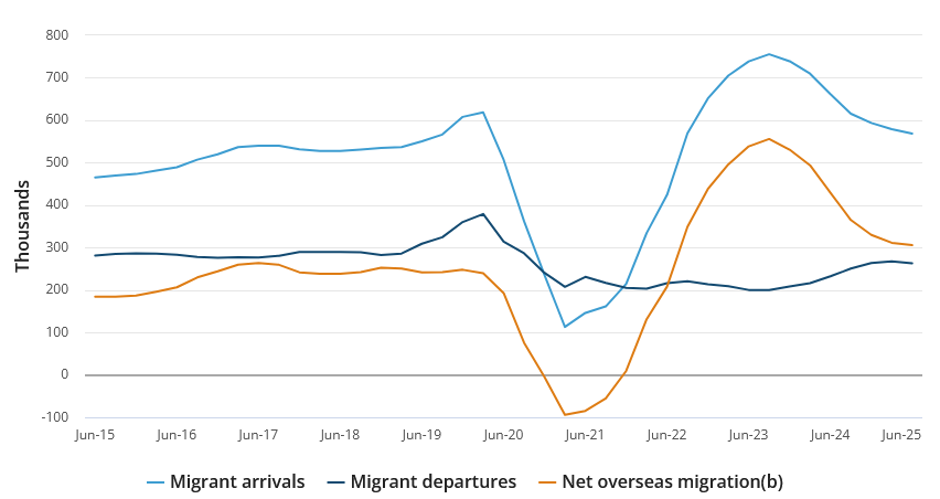
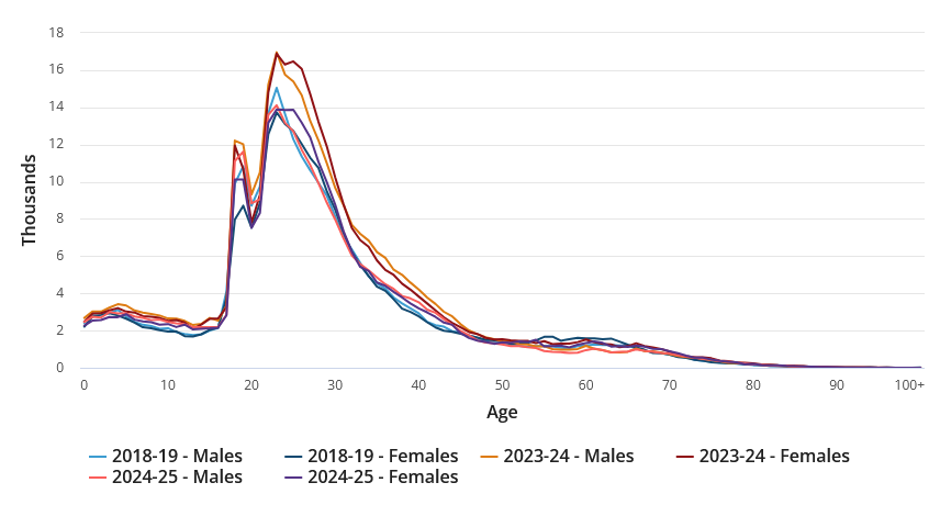
First chart has the net migration figures.
The second chart has the age group make up. (I was looking for last years figures but this graph from ABS also has a comparison of the pre Corona years)
As you can see there is a huge spike of people in the mid 20’s age group that are immigrating.
It would seem there is little impact on aged car and business that service middle age onwards. Albeit, in the coming years this may grow as the current immigrants become older. Essentially we may have a large ‘group’ ageing in the future as the same time. Bit like the boomers did before.
Perhaps a little impact on child related infrastructure and services, but more than likely simply replacing some of the capacity in this area due to lower local births.
What does this mean for local household formation (point 2 above)?
If the normal household formation is around the 25 year old age bracket and the most number of immigrants coming into and staying in Australia , are in THIS age bracket, there is severe competition for housing accommodating that age bracket.
This is compounded by the fact that we need to look at birthrates 25 years ago, to get the number of 25 year olds now.
Guess what?
For most of the 1990’s number of births was pretty constant. However from mid 2000’s it jumped upwards.
Check out this graph:
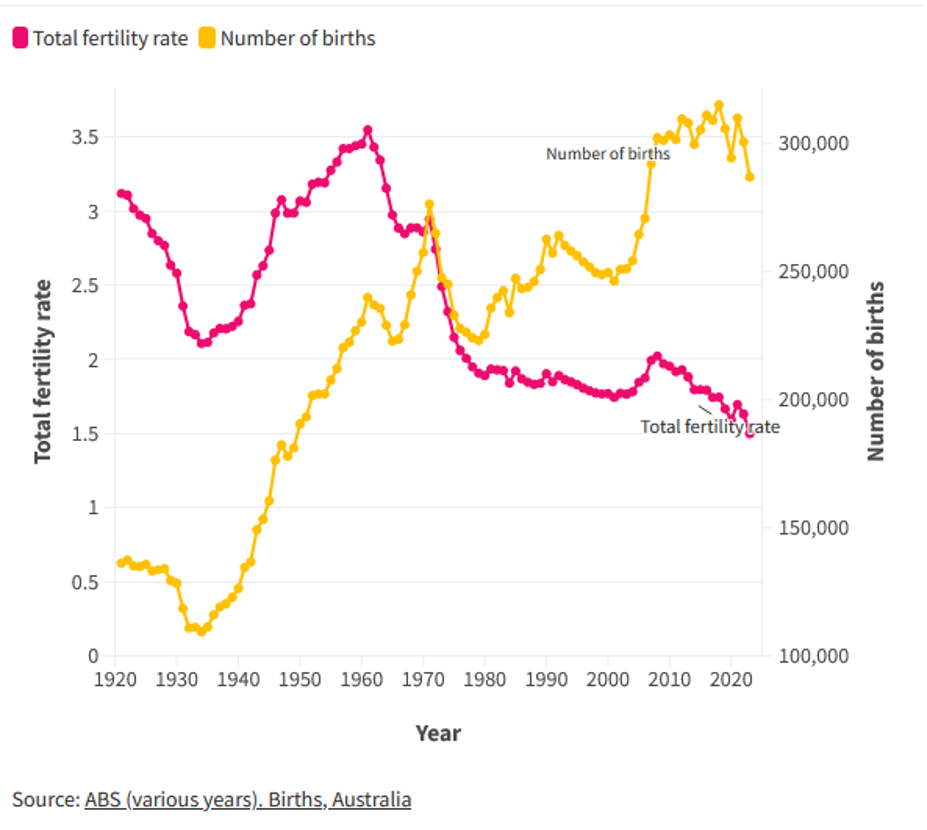
This means that in the next 20 years (peaking from around 2030 onwards) we have up to and over 300,000 local born Aussies, at the housing formation stage of life, joining with the largest group of newly imported immigrants also doing the same.
This here is the absolute crux of our housing crisis.
It is the reason why there is so much demand on a specific property type as first home buyers, new household formers (renters), immigrants, students and downsizers all gravitate to a similar property size or style.
Any wonder investors are interested in this market too, they simply gravitate to where the demand is.
Clearly this is causing problems and will continue to do so in the coming years. If immigration stays at similar amounts and demographic, make up then it will progressively get worth over the coming 4 years with the peak birth numbers from the later 2000’s to the early 2010’s all coming of age for housing formation.
Interesting times ahead indeed.
I think the one things this shows is that some subsections of the property market are about to be further smashed by an extraordinary large number of people crunching on that stock/price point and the one time.
That’s what I will dig into in the next installment of this series on population, procreation and property.
Have a great day
Scotty North
Links used:
Core national data sources
ABS — Births, Australia
Used for Australian fertility rate, birth numbers, replacement-rate comparison.
https://www.abs.gov.au/statistics/people/population/births-australia/latest-release
ABS — National, State and Territory Population
Used for population growth, births/deaths/natural increase, net overseas migration.
https://www.abs.gov.au/statistics/people/population/national-state-and-territory-population/latest-release
ABS — Overseas Migration
Used for migrant arrivals, departures, net migration, median age of arrivals, visa/age.
https://www.abs.gov.au/statistics/people/population/overseas-migration/latest-release
ABS — Household and Family Projections, Australia
Used for household projections, household formation/living arrangement.
https://www.abs.gov.au/statistics/people/population/household-and-family-projections-australia/latest-release
ABS — Housing Occupancy and Costs
Used for average household size, bedrooms per dwelling, spare bedrooms and housing suitability.
https://www.abs.gov.au/statistics/people/housing/housing-occupancy-and-costs/latest-release
ABS — Housing: Census
Used for dwelling type mix, unoccupied dwellings, national housing stock structure.
https://www.abs.gov.au/statistics/people/housing/housing-census/latest-release
ABS — Housing Suitability Census Dictionary
Used for the concept of bedroom suitability / overcrowding / spare bedrooms.
https://www.abs.gov.au/census/guide-census-data/census-dictionary/2021/variables-topic/housing/housing-suitability-hosd
Housing supply / approvals / completions
ABS — Building Activity, Australia
Used for dwelling completions, commencements and supply-side.
https://www.abs.gov.au/statistics/industry/building-and-construction/building-activity-australia/latest-release
ABS — Building Approvals, Australia
Used for dwelling approvals and approvals versus completions distinction.
https://www.abs.gov.au/statistics/industry/building-and-construction/building-approvals-australia/latest-release
Shortage / target / policy discussion
National Housing Supply and Affordability Council — State of the Housing System 2025 Report PDF
Used for underlying demand, net additions after demolitions, 2024 shortfall, and distinction between demand, supply and Accord target.
https://nhsac.gov.au/sites/nhsac.gov.au/files/2025-05/ar-state-housing-system-2025.pdf
Treasury — National Housing Accord
Used for the 1.2 million homes / 240,000 homes per year government target.
https://treasury.gov.au/policy-topics/housing/accord
Household size / suppressed demand
RBA — Housing Market and Household Size Speech
Used for the point that household size materially changes dwelling demand, including the RBA’s statement that returning to 2.8 people per household would imply about 1.2 million fewer dwellings needed.
https://www.rba.gov.au/speeches/2024/sp-ag-2024-05-16.html
Homelessness / rough sleeping / hidden shortage
AIHW — Homelessness and Homelessness Services
Used for rough sleeping versus severe crowding and broader homelessness.
https://www.aihw.gov.au/reports/australias-welfare/homelessness-and-homelessness-services
ABS — Estimating Homelessness: Census
Used for Census homelessness figures and categories.
https://www.abs.gov.au/statistics/people/housing/estimating-homelessness-census/latest-release
AIHW — Housing Assistance in Australia: Households and Waiting Lists
Used for public housing waiting list / social housing stress.
https://www.aihw.gov.au/reports/housing-assistance/housing-assistance-in-australia-2024/contents/households-and-waiting-lists
Short-term rentals / holiday homes
AHURI — Short-term Rental Accommodation Research Report
Used for short-term rental impacts, whole-dwelling STRs and localised housing impact.
https://www.ahuri.edu.au/research/final-reports/451
AHURI — Short-term Rentals Event / Research Summary
Used for short-term rental listing and housing pressure.
https://www.ahuri.edu.au/events/short-term-rentals
Since 2004, Scotty North has been helping people buy the best properties for their needs at prices that simply speak for themselves. Scotty has been instrumental in bridging the gap between financial planning and traditional real estate transactions through his property advice model.
Scotty North is a Qualified Property Investment Advisor (QPIA), with accreditation’s in financial planning, mortgage broking and real estate.
By carefully considering his clients’ goals and planning for market changes via demographics and trends, Scotty designs a future proof outcome not only specific to the client’s needs but dynamic in its execution with performance indicators and exit strategies built in.